The agentic AI platform for enterprises that need control over their agents.
RapidAI is RapidData’s production-grade agentic AI platform. Build agents on a no-code canvas, orchestrate multi-step workflows, ground them with your data and RAG, and route requests across an LLM Mesh — all behind one identity, audit, and governance plane.
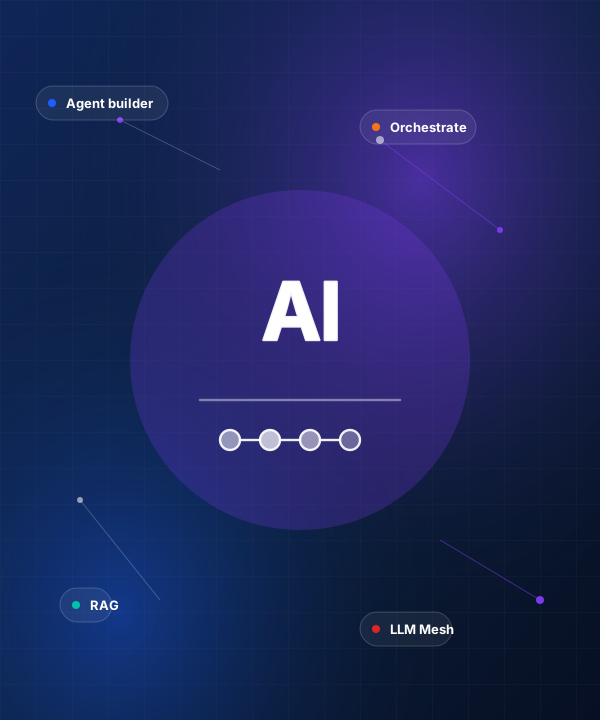
Build, orchestrate, connect, govern.
Most agent platforms ship two of these and call it a stack. RapidAI ships all four under one identity, audit, and observability plane — with the connectors, RAG, and LLM Mesh already wired.
A no-code canvas where business and engineering meet.
Drag, drop, connect. Reusable tools, prompts, retrieval blocks, and human-in-the-loop steps mean engineers ship the patterns and sector experts compose the journeys.
- Visual node-graph builder for agents, pipelines, workflows
- Library of pre-built tools — search, summarise, classify, extract, decide
- Versioning, branching, A/B variants, and rollback by design
- Embedded sandbox: run a single step with synthetic data in one click
Multi-agent chains that behave under audit, not just under demo.
Coordinator and sub-agent patterns with shared memory, supervised handoff, retries, conditional branches, and abort-on-policy. Built for production traffic, not screenshots.
- Coordinator + worker patterns with shared memory and tool routing
- Human-in-the-loop checkpoints with per-step approval policies
- Conditional branches, retries, fallbacks, and timeouts as first-class
- Run histories that replay deterministically for regulators
Your data, your tools — grounded in retrieval.
Plug RapidAI into 120+ enterprise systems, ingest documents and tickets, and ground every response with citations. RAG that your data office, not just your demo, can defend.
- 120+ first-party connectors (Salesforce, ServiceNow, SAP, Snowflake, Databricks, M365)
- Tenant-isolated vector indexes with citation enforcement
- Source-of-record provenance, freshness windows, right-to-be-forgotten
- LLM Mesh: route across 9 model providers by cost, latency, residency, risk
Guardrails that hold when the demo is over.
Content firewalls, prompt-injection defence, PII redaction, output policy, kill-switch, and SR 11-7 model risk records — generated by the platform, not bolted on.
- Per-agent model cards, eval evidence, change records
- Content firewalls and prompt-injection defence in the request path
- Cost and token telemetry per agent / tenant / regulator
- Sovereign deployment in three jurisdictions today
Nine providers. One request path.
Routing rules by cost, latency, residency, and risk. Failover that doesn’t require a hotfix. Provider switches that don’t require a rewrite. The Mesh is the abstraction your CIO has been waiting for.
Retrieval that cites, not hallucinates.
Every answer is bound to its source. Every chunk has provenance. Every index respects tenant boundaries. Your data office signs once — and re-signs only when the data classification actually changes.
Citation-first
Every retrieved chunk is bound to its source-of-record. No source, no answer — by policy, not preference.
Tenant-isolated
Vector indexes, prompts, and traces never cross tenant boundaries. Right-to-be-forgotten is honoured at the index level.
Freshness windows
Per-collection TTLs, scheduled re-indexing, and stale-citation flags. Knowledge ages on a schedule you control.
Eval-driven
Continuous evaluation harness scores precision, recall, citation accuracy, and groundedness on every release.
Two seats at the table. One agent.
Engineering builds reusable tools, prompts, and policies once. Sector experts compose them into journeys without code. The result: agents that ship the way the business wants them and run the way engineering needs them to.
Reusable tools, policies, and patterns.
- Tools defined in code, exposed in the canvas
- Policy-as-code: model selection, redaction, rate limits
- SDKs in TypeScript and Python; OpenAPI for the rest
- CI/CD: agents are versioned, tested, and promoted like code
Compose journeys. Skip the JIRA queue.
- Drag-and-drop canvas with natural-language prompts
- Sandbox runs in one click — no infra knowledge required
- Side-by-side compare for prompt and model variants
- Approver workflow built in: legal, risk, sponsor sign-off
What ships with RapidAI.
No-code agent builder
A visual node-graph canvas with reusable tools, prompts, retrieval, and human-in-the-loop steps. Engineers ship reusable patterns; sector experts compose journeys without writing code.
Multi-agent orchestration
Coordinator and sub-agent patterns with shared memory, supervised handoff, retries, and abort-on-policy. Built for chains that have to behave under audit, not just under demo.
Data integration
120+ first-party connectors — Salesforce, ServiceNow, SAP, Workday, Snowflake, Databricks, Confluent, GitHub, Jira, Microsoft 365 — all behind a single identity and policy plane.
RAG done right
Tenant-isolated vector indexes, citation enforcement, source-of-record provenance, freshness windows, and right-to-be-forgotten. The retrieval layer your data office can sign.
LLM Mesh
Pluggable across OpenAI, Anthropic, Google, Bedrock, Llama, Mistral, Cohere, Ollama, sovereign models. Routing rules by cost, latency, residency, and risk — no rewrites when you switch.
Production guardrails
Content firewalls, prompt-injection defence, PII redaction, output-policy enforcement, rate limiting, and kill-switch architecture proven on two production incidents.
Audit-grade observability
End-to-end traces, evaluation harnesses, drift detection, cost telemetry — per agent, per tenant, per regulator. SR 11-7-aligned model risk records ship by default.
Sovereign deployment
Run RapidAI on AWS, Azure, GCP, OCI, on-prem Kubernetes, or sovereign cloud. Live in three jurisdictions where data residency is a regulatory requirement, not a preference.
Outcomes you can hold us to — by horizon.
Foundations
Outcome tree, baseline metrics, and a working pilot in production by day 90 — defensible with finance, signed off by risk.
Scale
Squad expansion across the next 2–3 value pools. Live-parallel cutovers. Capability uplift inside the client team.
Run & optimise
Managed run with named SLOs, quarterly value reviews, and a continuous-improvement budget reserved for innovation, not toil.
Where RapidAI is running today.
AI underwriting
9 days → 14 minGCC sovereign bank deploys AI underwriting in 11 months
Read case studyAI fraud detection
−71% false positivesLeading Middle East Bank ships AI fraud detection — false-positive rate cut 71%
Read case studyConversational AI
−44% handle timeLeading Kuwaiti bank ships AI conversational banking — handle time −44%
Read case studyThree commercial models. One outcome standard.
We avoid open-ended retainers. Every model names its outcome and its measurement window in the contract.
Fixed-price diagnostic
2–4 week engagement. Outcome tree, baseline metrics, prioritised value pools, and a board-ready 18-month roadmap. Stop-go decision in week 4.
Outcome-linked pilot
8–12 week engagement to ship one value pool, end-to-end, with a measurable KPI commitment. Joint squads with the client team. Live-parallel before cutover.
Programme + managed run
Multi-quarter scale-out with managed services on top. Quarterly value reviews. SLO-tied annual incentive. Capability transfer by design.
Frequently asked questions
How is RapidAI different from a framework like LangChain or CrewAI? +
Frameworks give engineers code; RapidAI gives enterprises a platform. No-code canvas, LLM Mesh, RAG, governance, observability, and sovereign deploy are not features you bolt on — they’re the platform.
How does RapidAI relate to RapidHub? +
RapidHub is the innovation marketplace where institutions discover FinTech and GovTech solutions. RapidAI is the agentic-AI platform on which agents run. They integrate — RapidAI agents can be listed on RapidHub and run inside its sandbox — but they’re separate products.
Which LLM providers are in the Mesh today? +
OpenAI, Anthropic, Google (Vertex), AWS Bedrock, Meta Llama (self-hosted), Mistral, Cohere, Ollama, and selected sovereign / regional providers. New providers added when they pass our security and observability bar.
Does RapidAI work with our existing data and MLOps stack? +
Yes. RapidAI plugs into Snowflake, Databricks, MLflow, SageMaker, Vertex, Azure ML, and your IdP. We don’t want to own your data plane — we want to govern your agent plane.
How is RapidAI priced? +
Per workload and per token, with bands by concurrency. Volume tiers and annual commitments available. Alerts fire at 70/85/100% of envelope — no surprise overages.
Can we self-host? +
Yes. RapidAI deploys to AWS, Azure, GCP, OCI, on-prem Kubernetes, or sovereign cloud. The control plane and data plane can be separated for high-residency deployments.
How do you handle prompt-injection and PII? +
A content firewall sits in the request path with detection rules for prompt injection, jailbreak patterns, and PII. Redaction is policy-driven per agent. Every block is logged and replayable for review.
How fast can a team ship their first agent? +
Median first-agent time, when starting from a marketplace pattern, is 11 days from sandbox to staging. Net new agents typically take 4–6 weeks including evaluation and governance review.
Bring a use case. Leave with an agent in your sandbox.
A platform partner runs a 90-minute working session with your team — we walk in with the canvas, the connectors, and the LLM Mesh; you walk out with a working prototype.